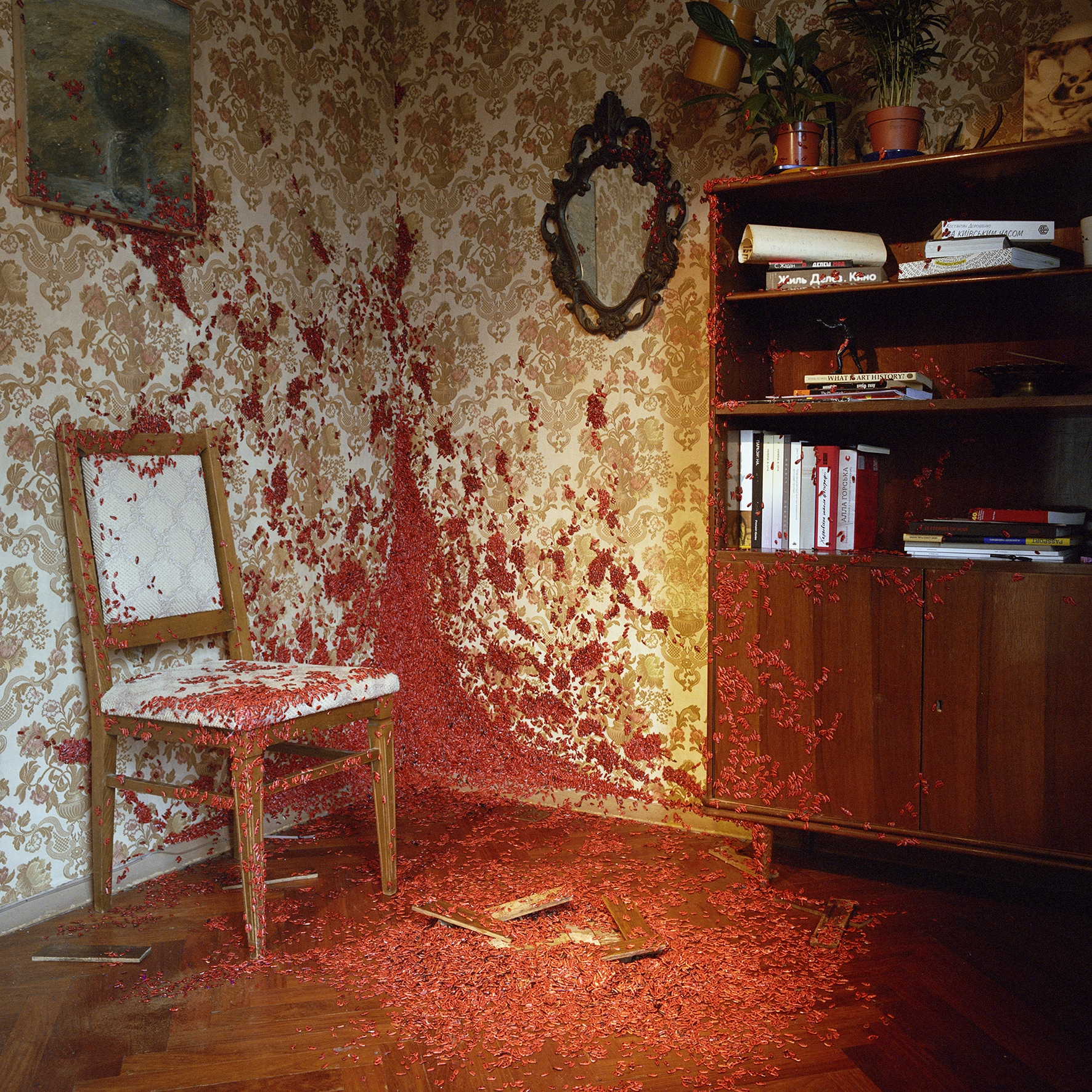
There is a room with wallpaper marked by reddish stains. Strange stains — they eat into the paper, the chairs, the paintings. They spread across the floor, destroying the wood, seeming to swarm. Then a close-up reveals the truth: the stains are in fact firebugs, those insects with scarlet shells. They infested the space, ravaged everything in it. They no doubt terrified its occupants, condemned to flee or endure the invasion, their bodies powerless before an improbable number of invaders. It is in such a setting that Olia Koval imagined “Eruption” — a mock documentary recounting the ordeal of R.B., a fictional artist who discovered, one morning, the sudden irruption of these insects in her home.
Trained at MYPH, the school of conceptual and artistic photography in Mykolaiv, and then at the University of Kyiv where she studied cinema, the Ukrainian photographer developed, since the Russian occupation of her country, “a series of installations in private spaces.” These long-term projects allowed her “to analyze the changes taking place within Ukrainian society,” which she rendered through “a considered approach guided by [her] emotions.” For “Eruption,” initially conceived as a simple staging in a friend’s bedroom, Koval ultimately built a genuine narrative: that of an anxiety-inducing invasion of insects emerging from the floorboards. A metaphor, of course, for the war her country endures. “The story brought a new dimension to the work. A human presence appeared, like a witness to this natural disaster,” she explained.
Illustrating horror
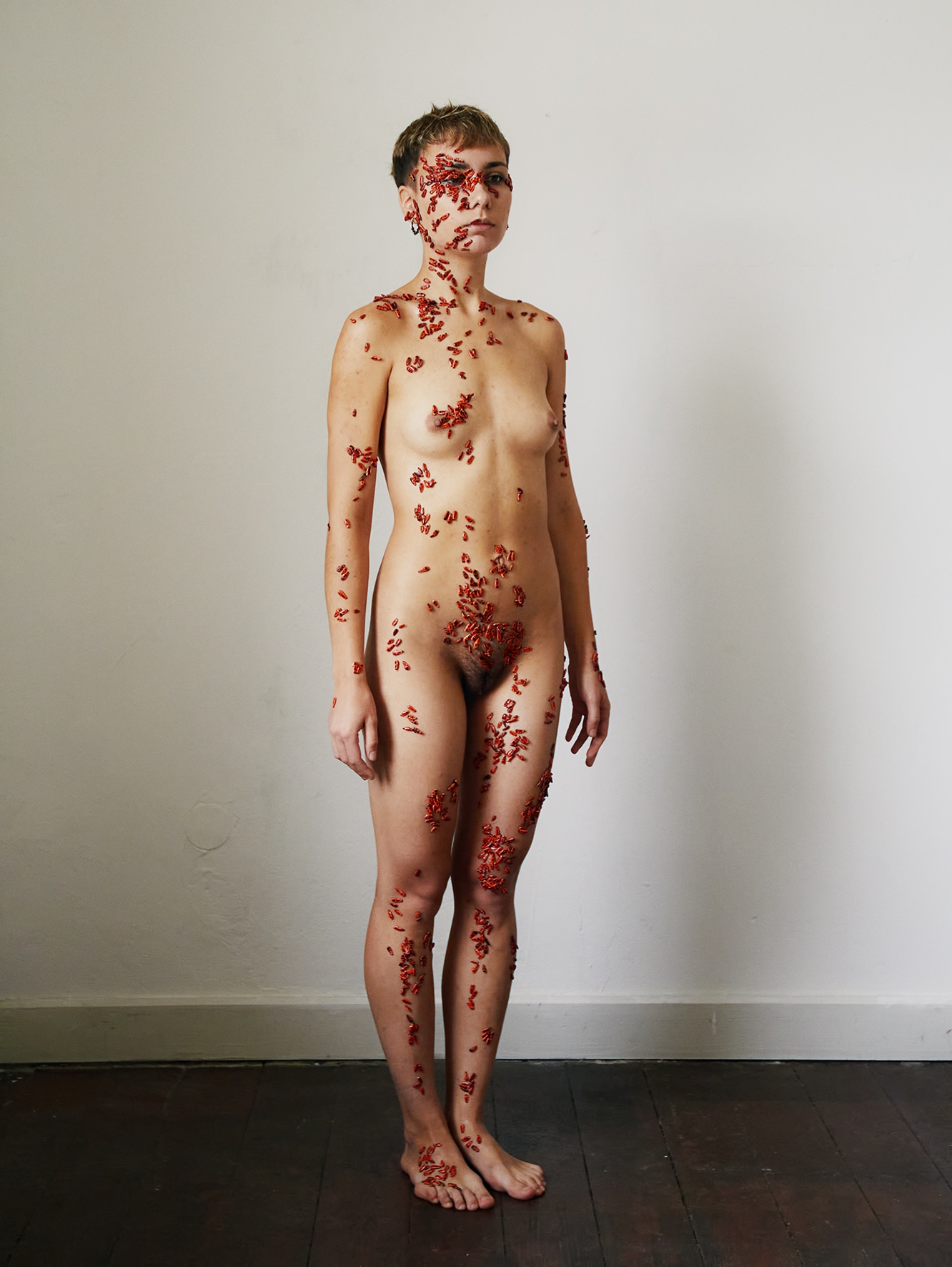
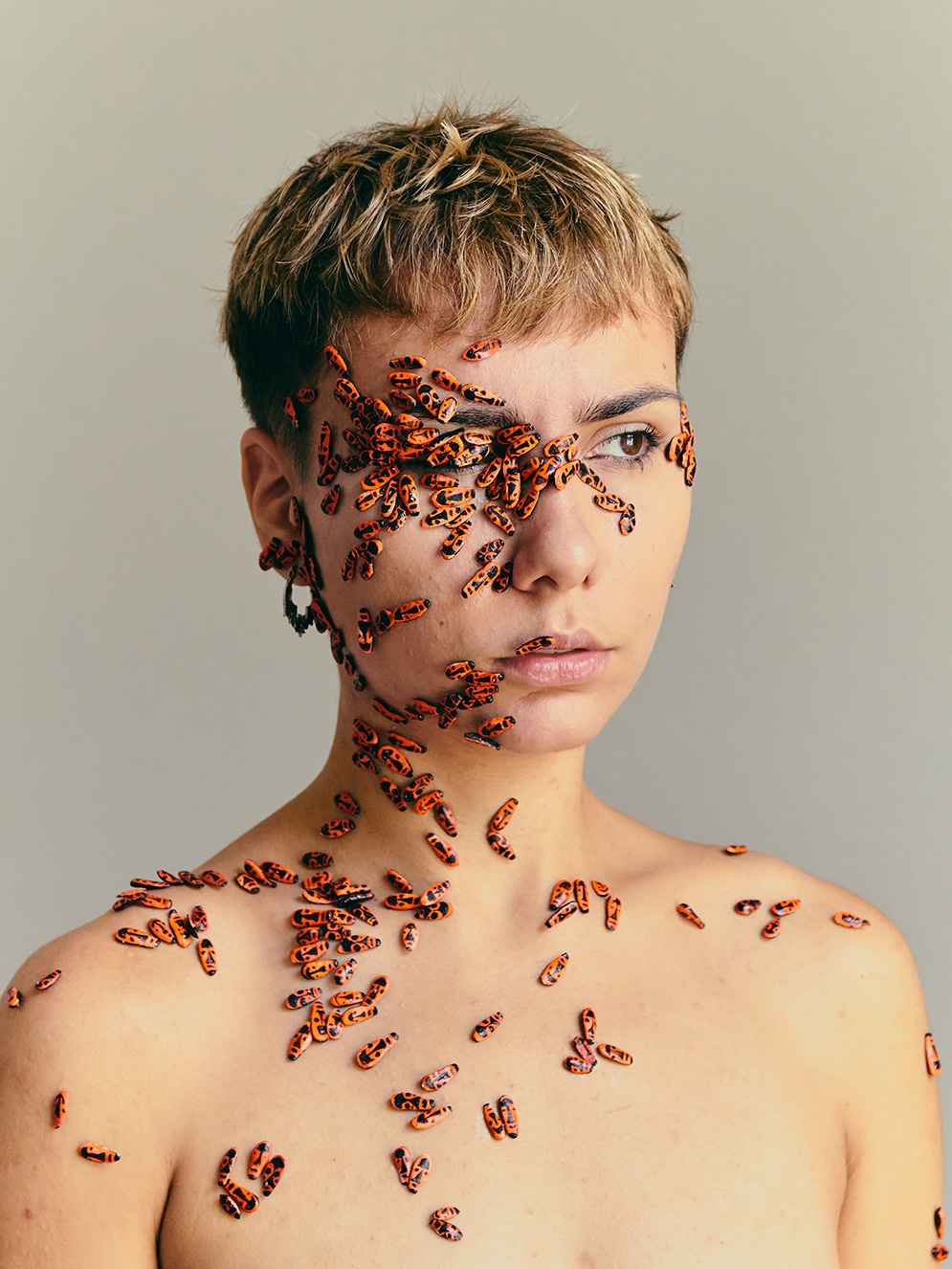
In her mother tongue, firebugs are called “soldier insects, in reference to the military of the Russian Empire, who wore uniforms of similar colors — shimmering orange and black,” the photographer confided. Naturally, then, she turned to these creatures to embody the irruption of an aggressive and implacable force into a given territory. She placed 40,000 firebugs in a room, filling the space with their very real presence. The invasion became actual, the occupation began: “they are small, but numerous, they deploy in an uncontrolled way, they transform the familiar into hostile terrain. We are no longer safe,” Koval summarized. Faced with the images, a feeling of discomfort, then anguish, emerged — emotions she heightened further still by covering a nude body with the insects’ red shells.
“For these images, there were no real insects — they were all made by me. There is no digital manipulation; my photographs simply document a construction, a staging,” the artist specified, adding: “It seemed important to me to place these firebugs directly on skin, to accentuate the notions of intrusion and vulnerability. The invasion, in this way, is not only of a space, but also of an intimate boundary.” Though still, the works remarkably conjured the idea of movement, of an animal covering over the human. A covering that pullulates and curiously contrasts with the expression of the protagonist: her gaze cast into the distance, she endured, powerless, the scurrying of legs, the mass of shells circulating over her body and even threatening to infiltrate her mouth, her nose, her eyes. “I wanted to illustrate the horror that takes hold of us when we can no longer live in a place that has always belonged to us, when it is occupied by a force alien to ourselves. A question then emerges: what can we do — resist, leave, or try to coexist?” the artist confided.


Preferring to leave the answer to the viewer, Olia Koval has since developed two new chapters of this project, titled “Penetration” and “Consumption.” “These explore the invasion of the human body and food. The climax of the story will take the form of a pregnant woman in a forest, assailed by firebugs intent on destroying her identity and autonomy from within. The act of eating becomes, in turn, a poisoning — a metaphor for the impossibility of nourishing oneself, feeling pleasure, or feeling safe,” she concluded.
“Eruption” is on view at the Circulation(s) festival from March 21 to May 17, 2026, at the Centquatre in Paris.