
Glaciers are perhaps the most visible incarnation of climate change. They are also the protagonists of “Glaciers,” the first chapter of the long-form series “Elegies” — meaning “mournful lament.” A word full of poetry to describe the violence of the world. In the continuity of “Vivants” (The Living) and his work in general, Matthieu Gafsou continued to explore ecology — except that here he chose a more intimate, more physical narrative. “Here, the mountain is part of a certain normalcy, even familiarity. Like many people, I go hiking and tried mountaineering when I was younger,” the Swiss photographer confided. The glacier? A fascinating, spectacular element that never loses its hold. “An extraordinary force, an enormous thing that could swallow us whole.”
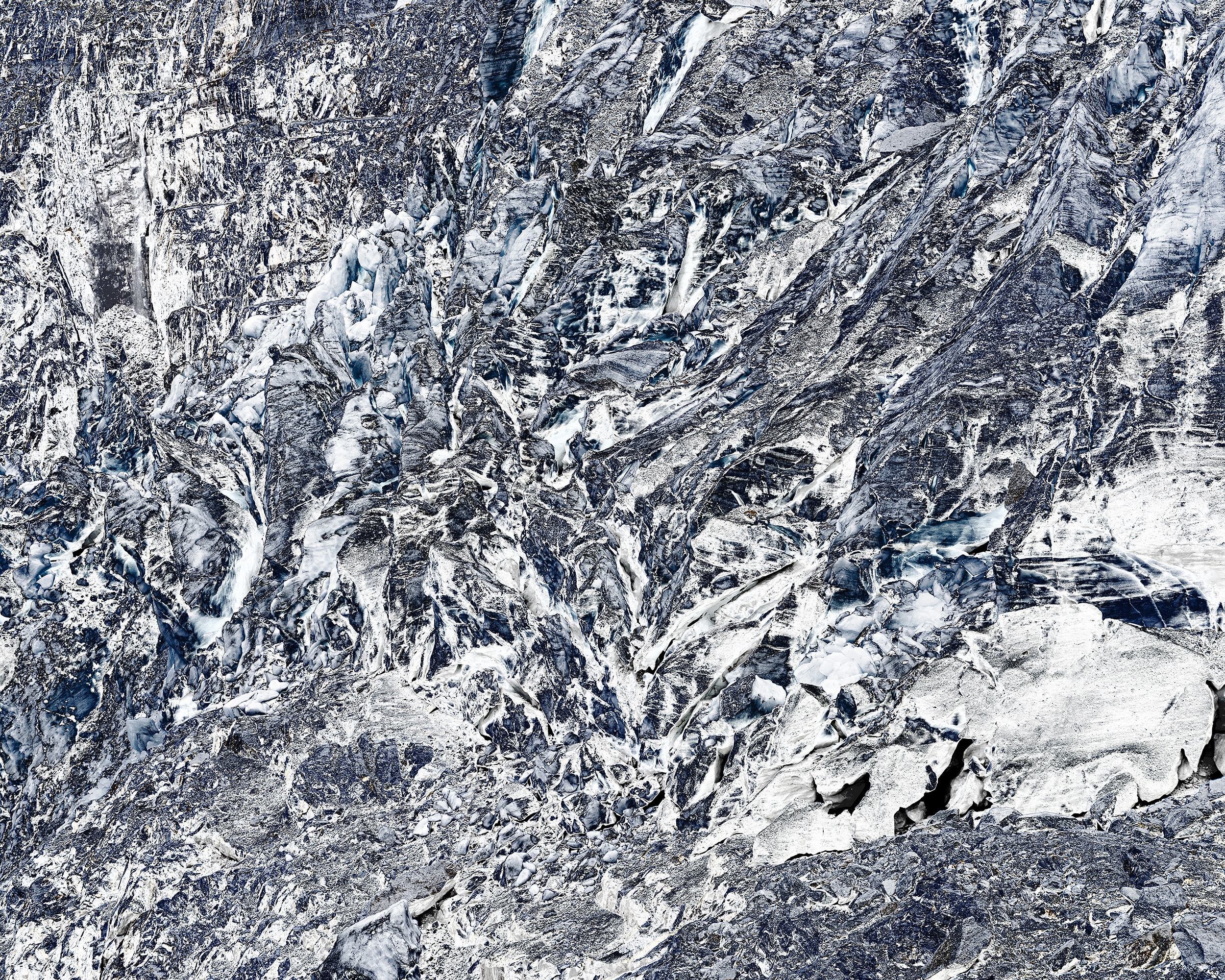
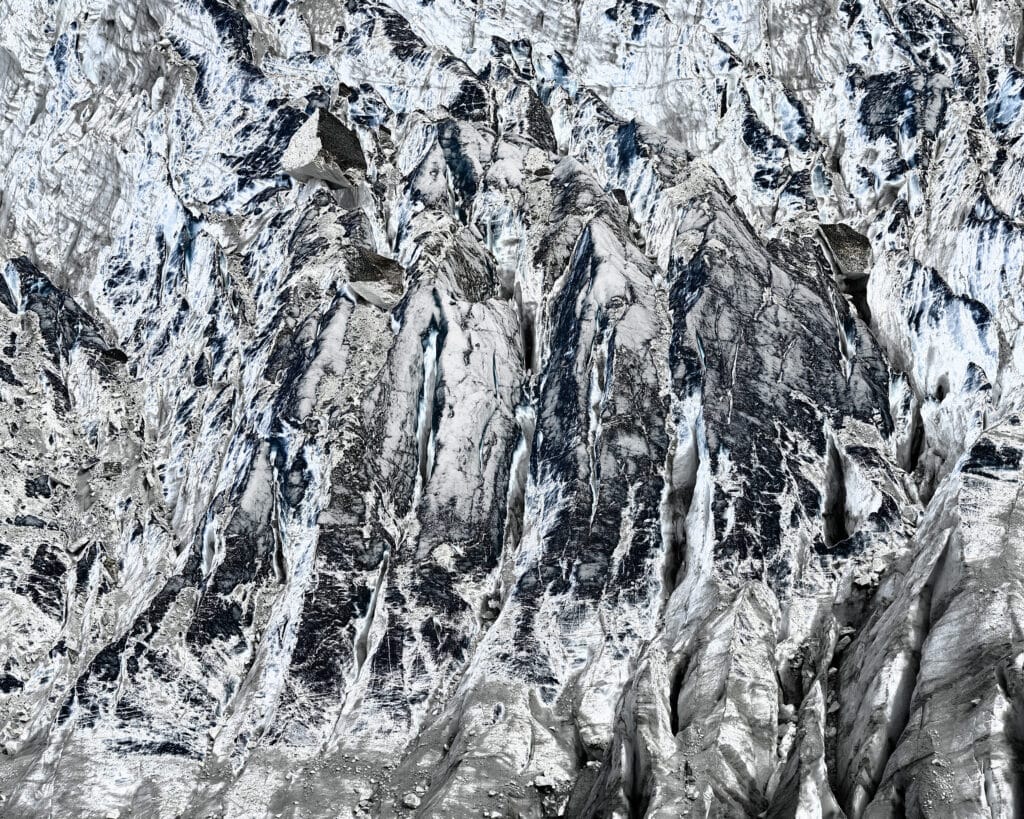
Usually talkative, he found himself at a loss for words when it came to describing these expeditions. There was no doubt: the mountain had to be lived. And it was lived in all its paradoxes. “If the imagination associated with glaciers evokes the sublime, there is also something resembling a field of ruins: the glaciers are retreating, access is increasingly difficult. All of this reinforces a certain romantic vision.” Rather than figures and studies documenting their disappearance, Matthieu Gafsou shared a poetic physicality — images at once sensory and melancholic.
Imminent deglaciation
“Roaming the territory, going there in person”: seeking out images rather than thinking them, feeling them rather than intellectualizing them. Merging with what surpasses us, looking nature in the eye as it continued to shine, and attempting to grasp the ungraspable. Confronting the elements: the cold, the instability of the ground, the dull sound of ice at work. Up there, the body was no longer a spectator — it became a fragile measure. “Everything’s fine,” “It’ll be okay,” read the text on some images. This was not about reassuring pessimists of open spaces. No need to strap on a harness and crampons to understand the irony: the mountain is a shifting territory, increasingly uncertain. And then: “If you set aside the human element, everything’s fine. The earth doesn’t care about our nonsense — it will outlive us.”
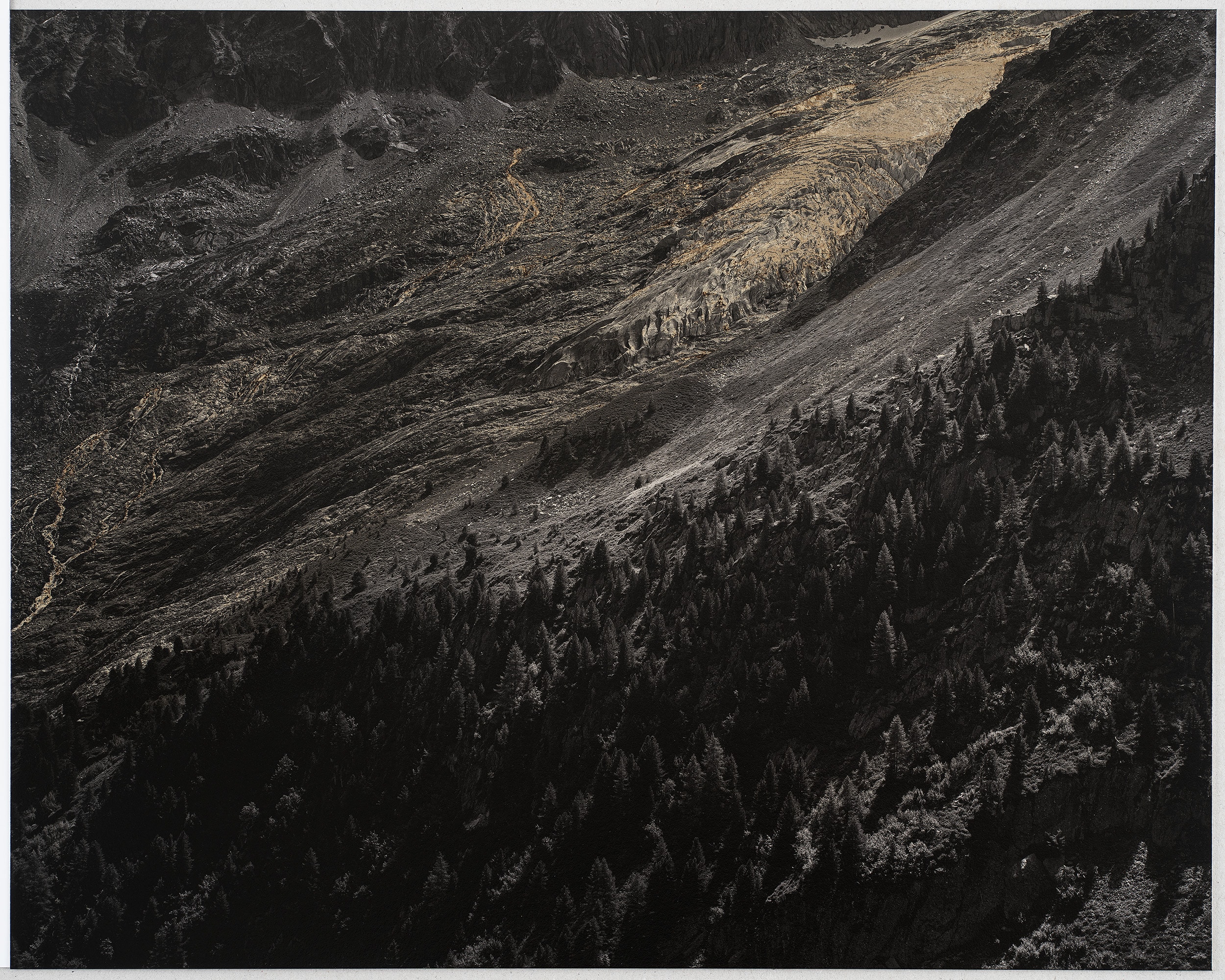
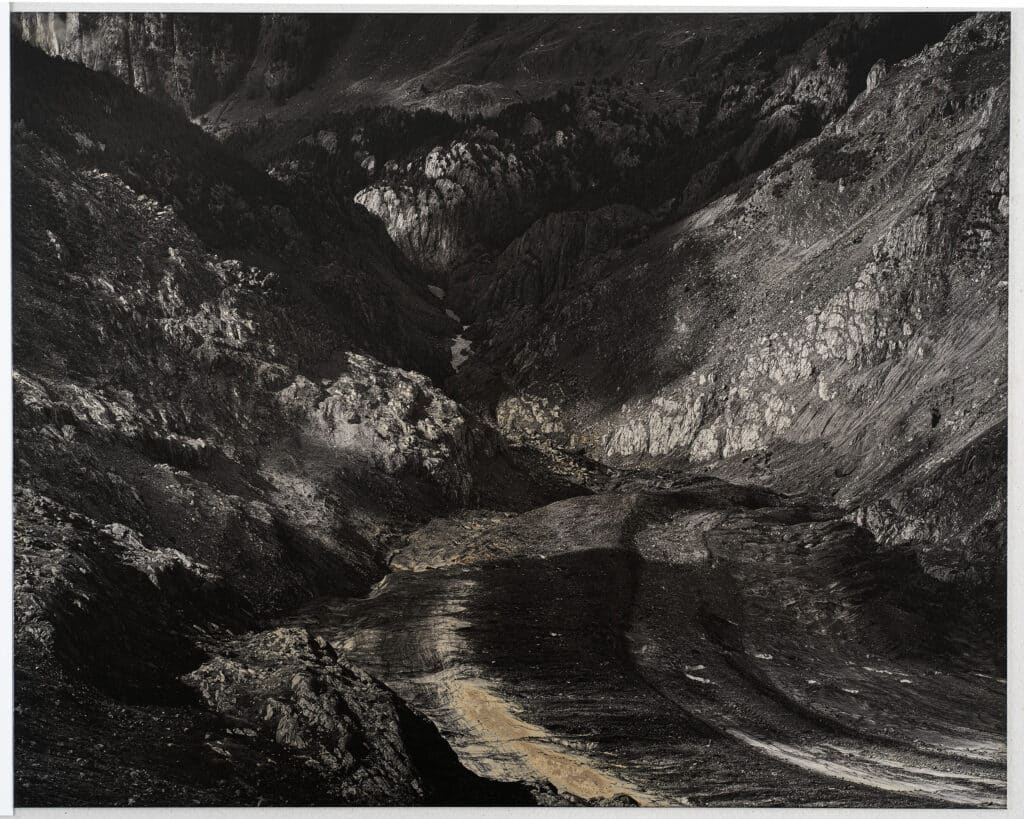
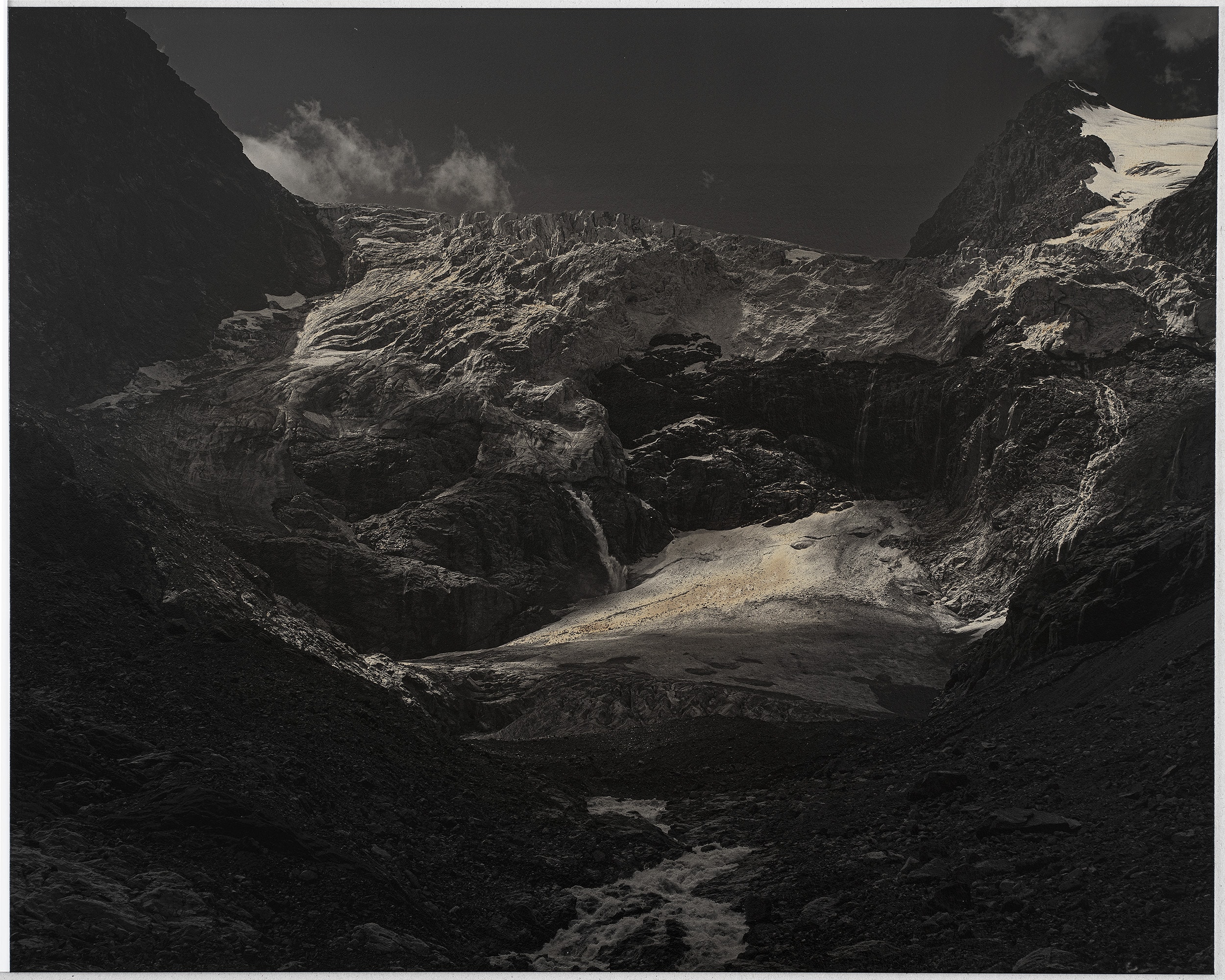
So how does one experience the grandiose? And how does one convey it? By penetrating the glacier’s innards, by imagining it sending us a distress signal, or by confronting the infinitely small with the infinitely large. In this project, Matthieu Gafsou continued his formal experiments. He played with water’s two states to evoke imminent deglaciation; he moistened his own prints, altering the very surface of the image. The work itself became matter — vulnerable, unstable.
Exposing contradictions
These tensions also ran through Trient, the video presented as part of the project. The journey toward the glacier became an experience in itself. The gaze was no longer only that of the photographer, but that of a technical apparatus — drone and camera — that conditioned our way of seeing. The further one advanced, the more the presence of the machine made itself felt: its hum invaded the space, a cacophony set in. The landscape, at first contemplative, became charged with a diffuse unease. The acceleration of the rhythm, the superimposition of images, and the visual saturation produced a kind of vertigo. The fascination for the glacial sublime collided with the trivial materiality of the tool used to approach it. By incorporating the drone — an emblematic object of technological and consumerist modernity — into his apparatus, Matthieu Gafsou did not sidestep the contradiction: he exposed it. He shed light on the ambivalence of an artistic gesture that depended on the same technologies contributing to the imbalances it documented.
With “Elegies” and its first installment “Glaciers,” Matthieu Gafsou did not merely document the transformation of Alpine landscapes: he moved through it, he felt it. The project extended the line of “Alpes” (Alps) and then “Vivants,” but shifted the center of gravity toward something more interior. Here, ecology was not a theme — it was a felt experience. Affect became the driving force. It irrigated both the substance of the images and their construction. Rather than delivering a verdict, Matthieu Gafsou established a tension — sometimes uncomfortable — that invited lingering. His photographs did not explain; they placed one in the presence of something. They made the fragility of an environment perceptible without reducing its complexity. This mixture of power and disappearance, of attraction and unease, ran through the entire series. The sublime was never pure: it was altered by time, by erasure, by a form of lucid bitterness. As for our gaze, it was held in a state of precarious equilibrium. Nothing was stable — neither the matter, nor the point of view, nor even our position as spectators. It was up to each person to inhabit this unstable zone and find their own intimate resonance. “Elegies” imposed nothing: it opened a space where the bond with the living could be reconfigured, somewhere between grandeur and unease.
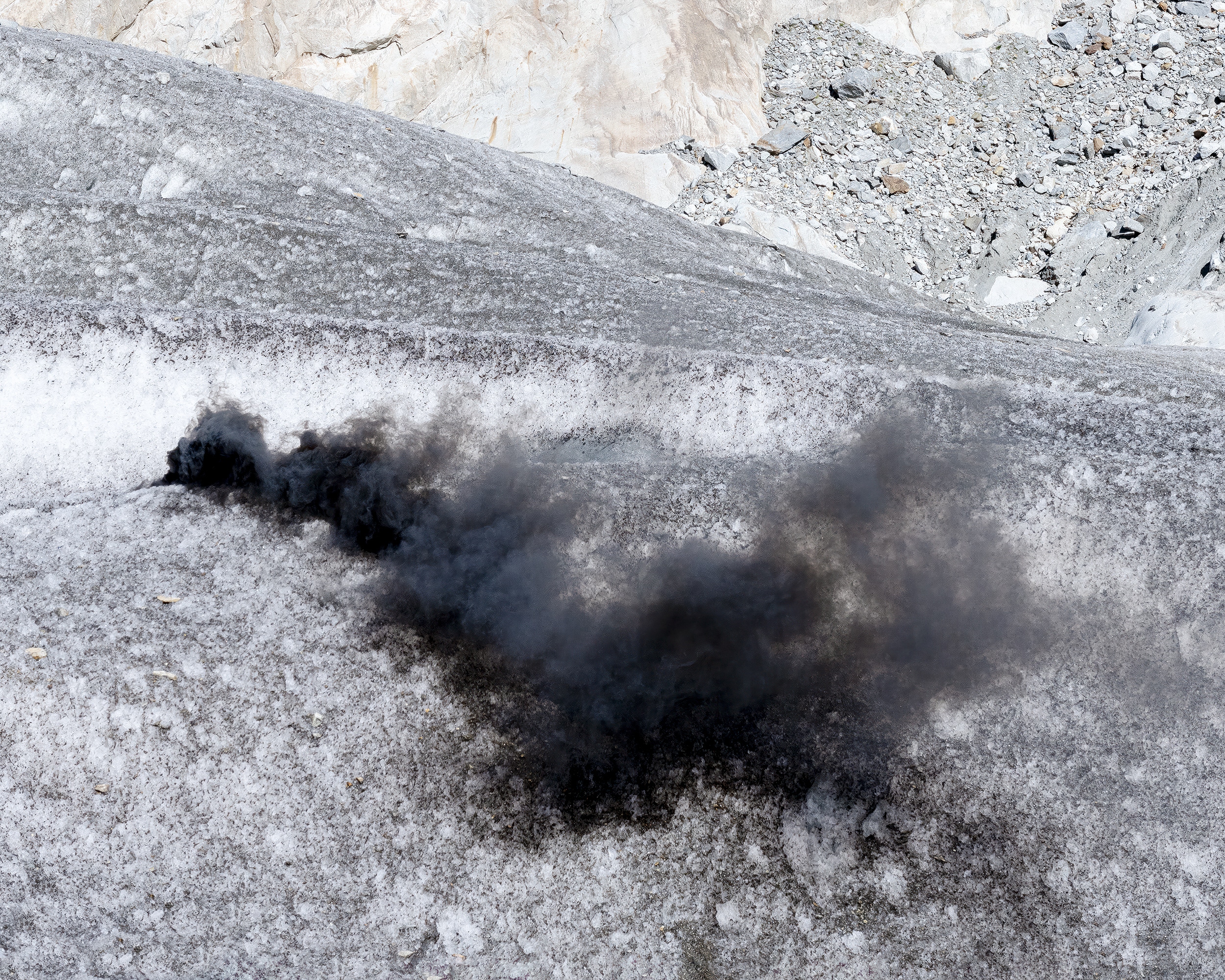
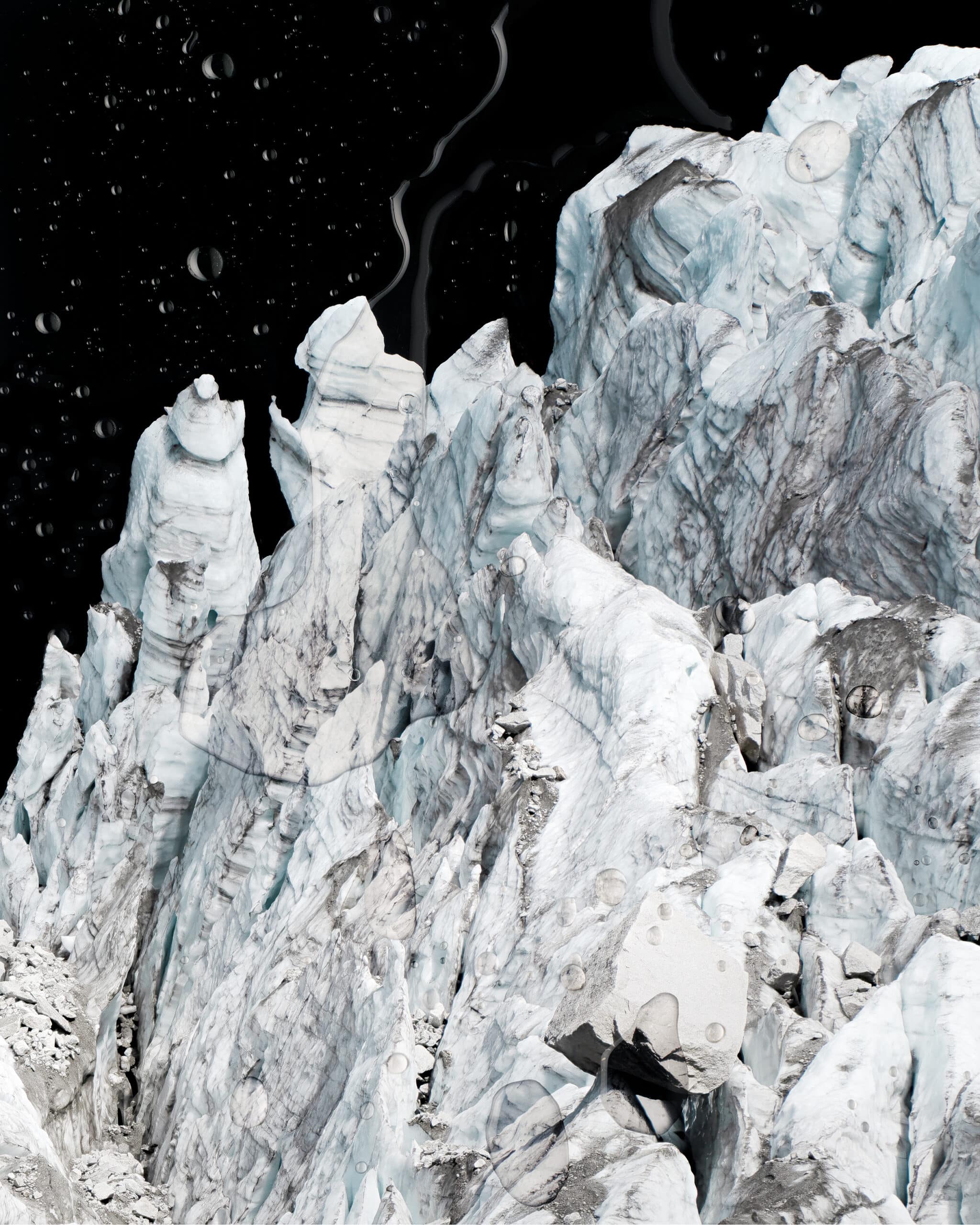
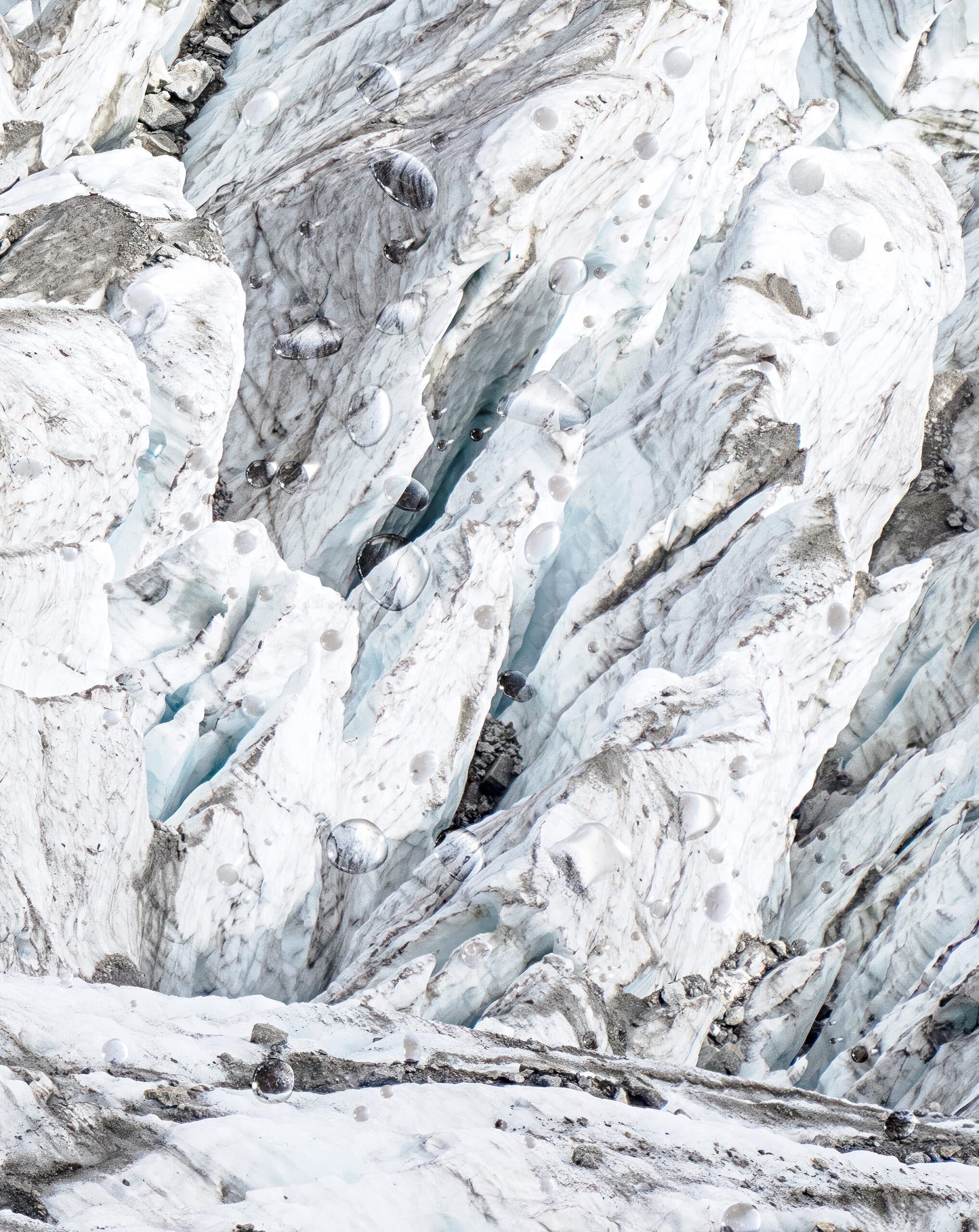
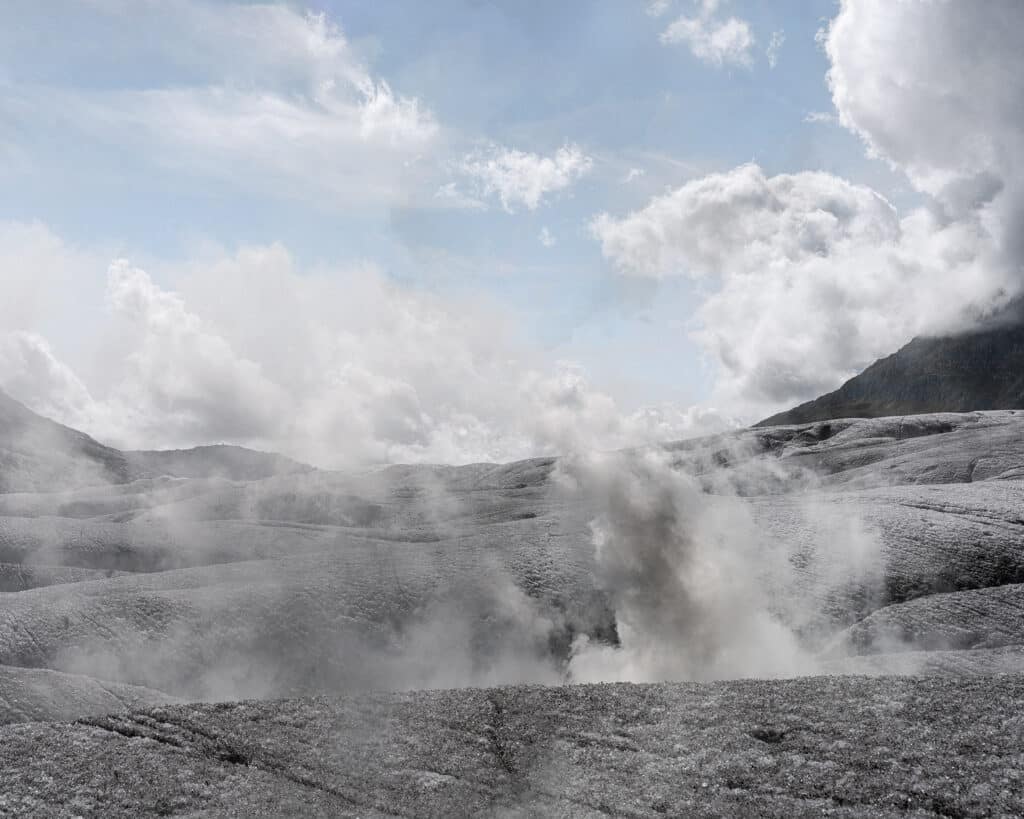
The words of Charles Baudelaire then resonated with this aesthetic of melancholic sublimity. In Mon cœur mis à nu (My Heart Laid Bare), he wrote: “I have found the definition of Beauty, of my Beauty. — It is something ardent and sad, something slightly vague, leaving room for conjecture. […] which carries an idea of melancholy, of weariness, even of satiety — or the opposing idea: an ardor, a desire to live, coupled with a bitter reflux, as if born of deprivation or despair. Mystery and regret are also marks of the Beautiful.” In Matthieu Gafsou’s glaciers, there was precisely that: an ardor and a sadness intertwined, the vertigo of a world fading away, and the troubling persistence of its beauty.