
Beneath the roofs of the Musée national de la Marine, in Paris, an invisible sea roars. Not the sea on maps, but the inner sea of photographer Jean Gaumy. For the first time, the Musée national de la Marine is dedicating a major exhibition to him. “Jean Gaumy and the Sea,” on display until August 17, 2025, brings together more than 140 photographs from the Médiathèque du patrimoine et de la photographie, representing nearly 50 years of photography. A lover of the sea and its silhouettes, the exhibition takes us on a long-distance journey through oceans, men, and machines, which the photographer has constantly explored since the beginning of his career in the 1970s. “Photographing is like fishing or writing. It’s about emerging from the unknown that resists and refuses to come to light,” says the photographer.
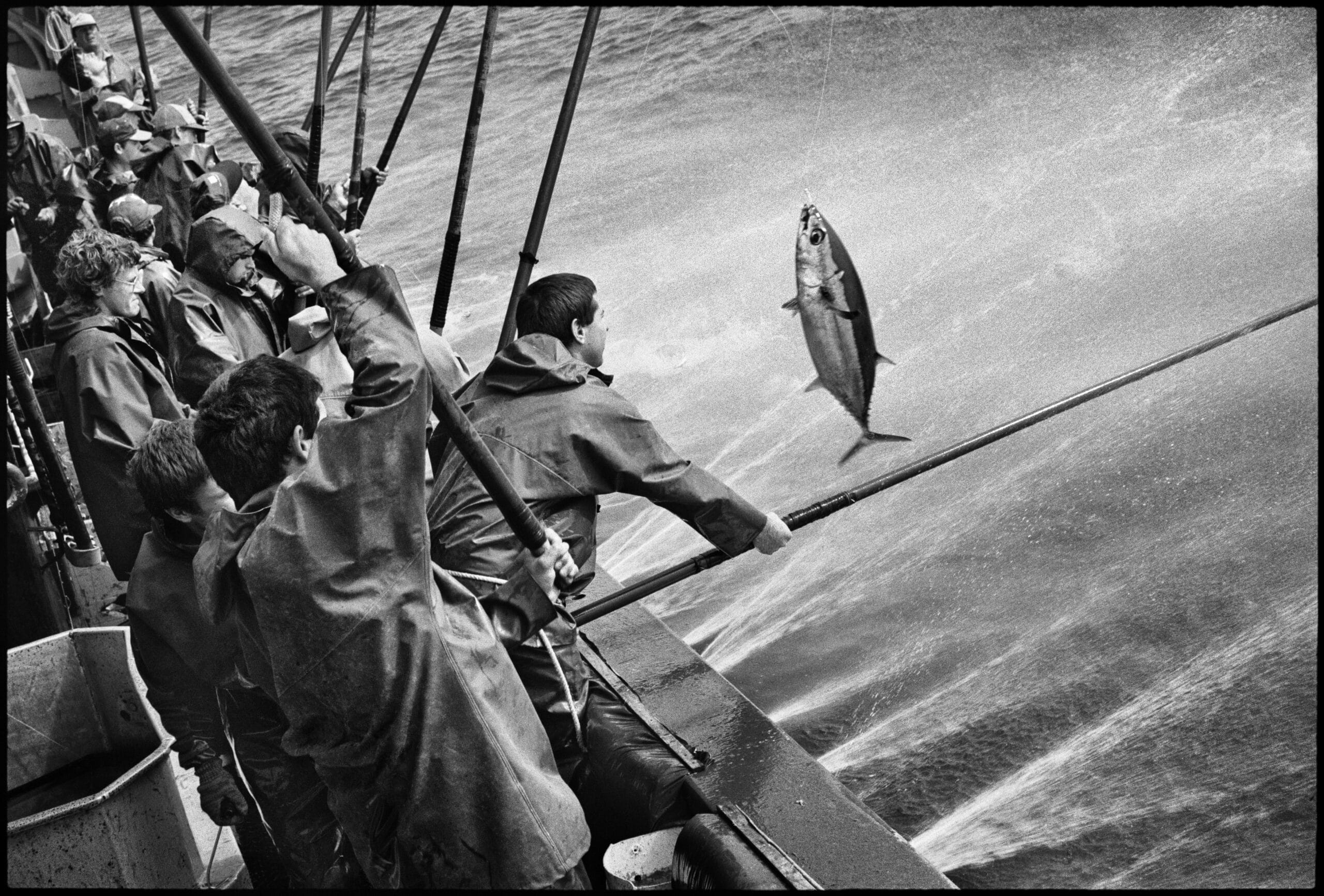
The exhibition opens with fishing, the founding arch of Gaumy’s work. Aboard Basque trawlers, North Atlantic longliners, on the beaches of Long Island, or in Normandy, the photographer has traveled the globe to capture marked faces, age-old gestures, a fatigue that needs no words. We encounter silhouettes in oilskins, boots buried in fish blood, damaged hands, gazes lost in the rolling waters. The smell rises from the images: salt, diesel, viscera. “The fishermen first understood that I respected them completely, then that I was deeply interested in them. I was also a fisherman before becoming a photographer. I had a sense of all that from the age of 7 or 8. The knots, the gestures, I understood them. And the fishermen saw it. They then gave me a rod.”
Between the gestures in action, singular faces emerge. Sadness, melancholy, fatigue: so many silent expressions cross their features. Some withdraw into their corners, as if to avoid contaminating the other sailors with their discreet sorrow on board. “If you haven’t been in osmosis with the crew for 15, 20, or 30 days, you have nothing. You don’t allow yourself to get close to a guy who is completely… who is not well. Really not well. Psychologically, the crew fell apart. They knew they were on a rusty boat. Instinctively, when I saw him back away from the others, I felt that this moment was important. I took 2-3 photos. Everyone was silent. We didn’t speak to each other.”

A significant portion of the photographs is devoted to his campaigns aboard the Rowanlea, a Spanish trawler, in 1998 and tugboat Abeille Flandre. The prints—often in dense, grainy, almost charcoal-like black and white—bear witness to a harsh, almost unreal daily life. The closed-door setting is omnipresent. Jean Gaumy does not photograph “the sea,” he photographs what it does to people, to bodies, to the mind. “It’s unbearable not to take photos,” he explains. “It’s unbearable to see time passing by and not being noted. You have to know that we think about photography every day, every hour. Photography is an animal. It’s not just a desire to leave a trace.”


Between fiction and documentary
Jean Gaumy reveals another facet of his work: a deep passion for cinema and painting, which nourishes and runs through his photographic work: “It’s a moment like in Rossellini’s film Stromboli, the guys sing and shout at the same time. There, what is very impressive is that at the moment when the tones darken on each other, they sense danger, they are in a panic. They [the fishermen] are simply waiting for them all to be destroyed, or at least for them to get injured or get tired.”


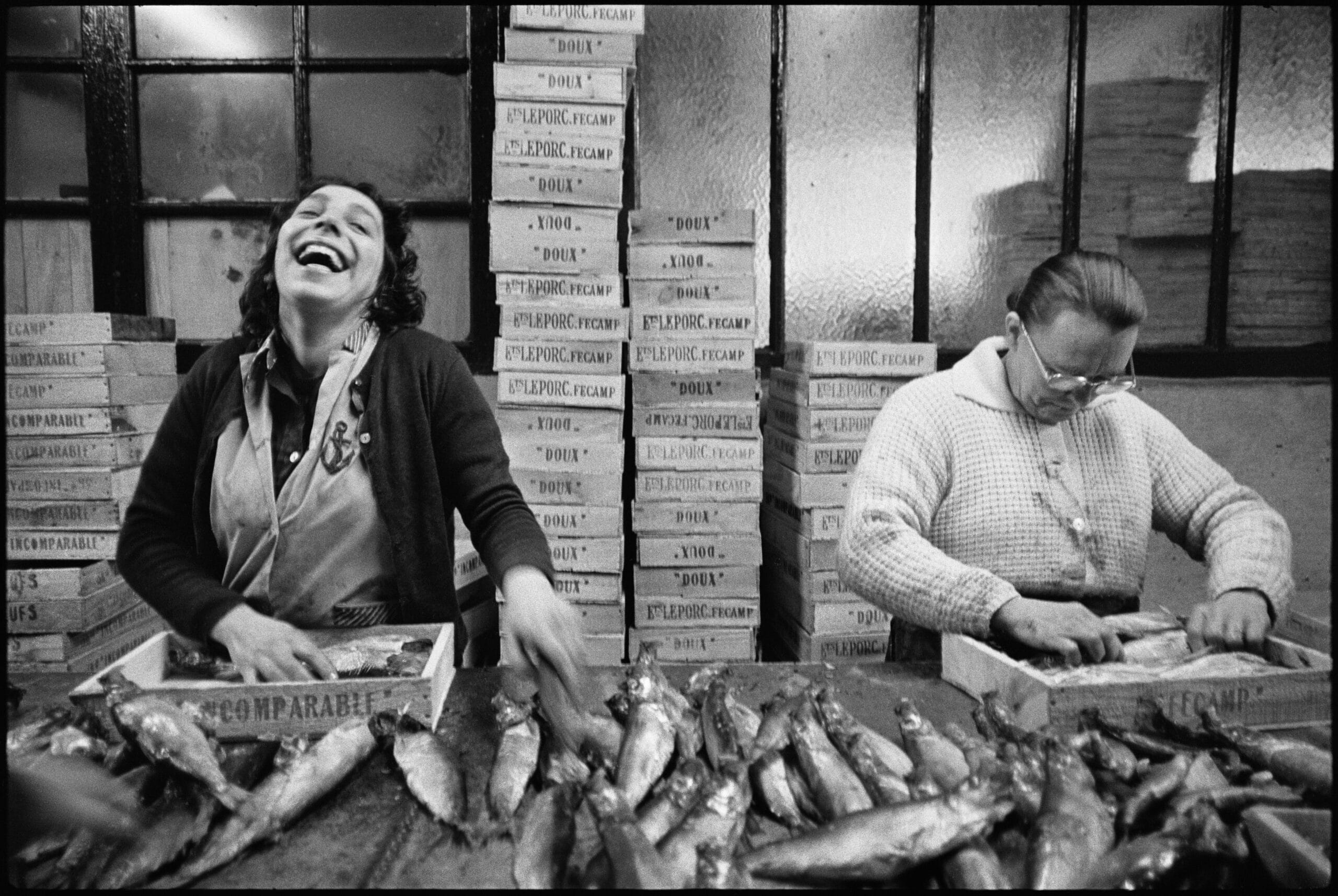
In 1977, he took a series of photographs in a smoked herring factory in Fécamp, Normandy. He documented the work of the workers, who, in difficult conditions, prepared the herring for shipment. These images bear witness to a world in the process of disappearing and marked the beginning of his interest in closed worlds and changing professions. “This body of work is a way of capturing a world that is disappearing.”
Ten years later, in 1984, Gaumy returned to Fécamp to make his first documentary film, entitled La Boucane. This 35-minute short film offers an immersion into the daily lives of these women, capturing their repetitive gestures, their conversations, and their camaraderie within the factory. The film highlights the dignity and resilience of these workers, while highlighting the harshness of their work environment. La Boucane was praised for its sensitivity and accuracy, notably receiving a nomination for the César Award (French Oscars) for Best Documentary Short in 1986. “They tell each other their stories, laugh together,” the photographer recalls. “In the film, you see it very clearly. That’s what I capture over one or two weeks on film. In fact, they act in front of me, and I act with them at the same time.” This work illustrates Jean Gaumy’s commitment to documenting often invisible realities, giving a voice and visibility to those who live and work in the shadows.
Then, we leave the deck of the boats to dive into the depths of the nuclear submarines. “These are closed worlds, the sea, the submarines, the prisons, the hospitals. What interests me is to enter these spaces where man is constrained, tense, and yet immensely strong.” There, the silence is total. The images taken within the French strategic oceanic force reveal another type of confinement: that of man facing technology, invisible decisions, the world suspended underwater. “All this technology was mind-blowing, amazing. I slept there with the crew, in the places where torpedoes are normally laid out. They asked me at the beginning if I wanted to go into a cabin, like on the carters. If I had been in the cabins, I wouldn’t have been aware of what was happening in the submarine, and I would have felt constantly frustrated, telling myself that I was missing something, a decisive moment. I told them to put me in the middle. And they said to me, at your age… I was 60. I shot back. No, Grandpa is not going to go up in the bunks with the others!” Images become closer, more intimate, the lights more raking, more striking, sometimes captured in infrared. The sea is muted.
A world adrift
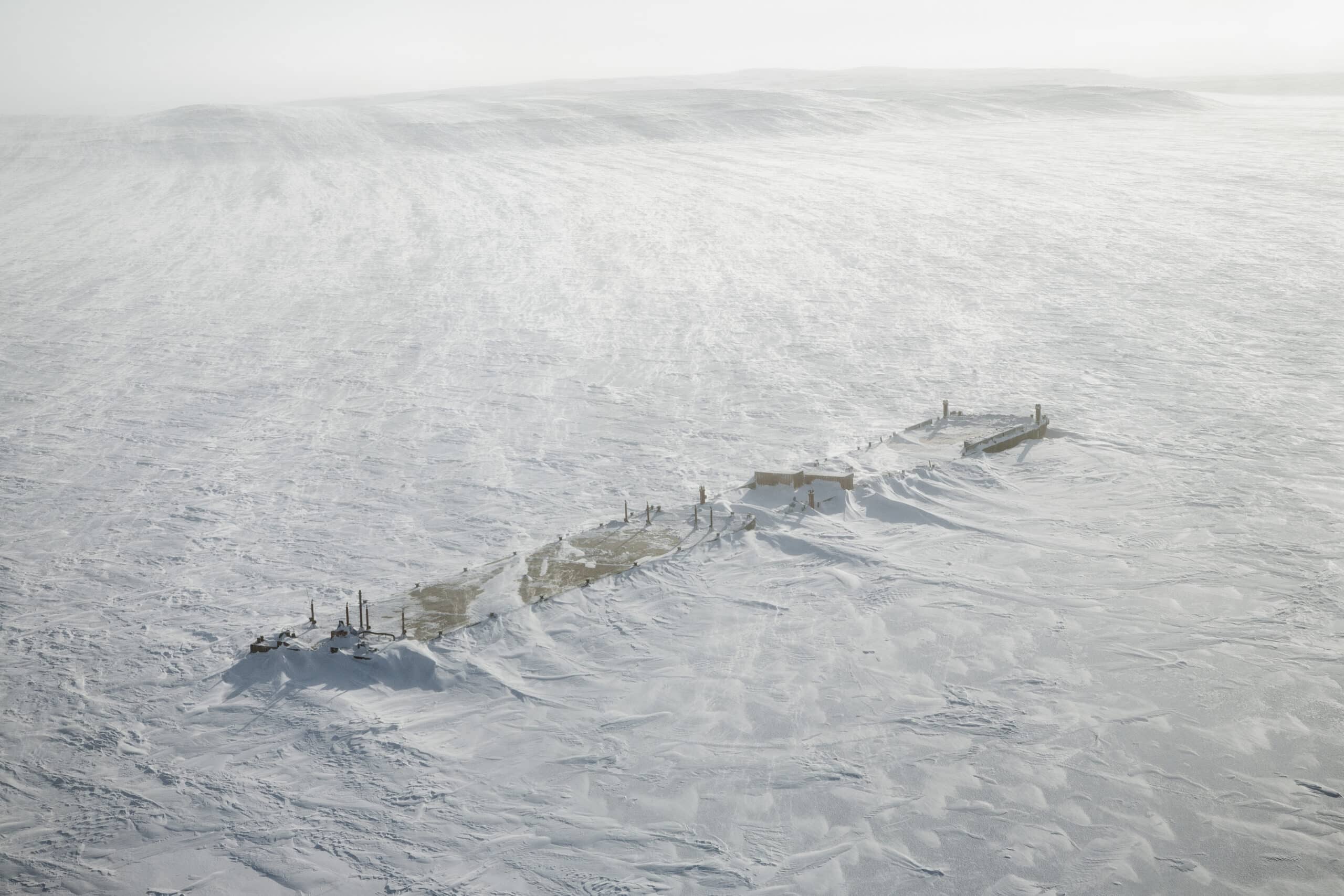
The exhibition extends to the frozen confines of the globe. Gaumy accompanied scientific missions to the Arctic, in Canada, documenting polar territories with the same rigor. We see white expanses, where man is a simple imprint in the ice. Some images border on abstraction, another phase of his work: a piece of iceberg, a wake in the mist, an indistinct shore. Nature becomes sovereign again. The photographer’s gaze becomes more contemplative, broader. “The cold was terrible,” says Gaumy. “With the scientists, in Greenland, in the polar night. It wasn’t folklore. It was real, intense. I was with a couple on the boat. And at that time, they were leaving with their two children. I went to join them during the polar night. I stayed with them for a month, two months.”

Another, more unexpected section takes us inside an aquarium in Coney Island in 1987. In this image of a captive beluga, it is still the sea, but a sea of concrete, glass, and reflections. Gaumy explores the question of the gaze—that of the animal, the spectator, the photographer. The poetry of the contrast between natural immensity and domesticity. The common thread of the exhibition is not purely narrative but a forceful one: that of the real, raw, harsh, but without ever giving in to miserabilism. “In certain situations, you can’t afford to miss. You feel it, it burns in your stomach.” Jean Gaumy doesn’t seek the spectacular or the picturesque. In some photographs, the eye lingers on a piece of hull, a patch of empty sky – so many details which, put together, tell the story of the world. ” You have to know your body, the light, the limits. A photographer is a bit like an orca who learns to hunt without wanting to eat, it’s purely the virtuosity of the gesture.”
The scenography highlights this diversity of approaches: large formats, more intimate prints, panoramic formats, photographs never before shown, extracts from documentaries. Some works are iconic, others more confidential, resulting from years of solitary work. For several years, Jean Gaumy has even taken some photos with his iPhone, reflecting his intact curiosity for all the tools capable of capturing the world. He rediscovers this pleasure of transforming his images, in the manner of the films of Rossellini, Murnau or Chris Marker, or even the paintings that deeply nourish his imagination: “I rediscovered the black and white of the 1930s with my iPhone,” he explains. “I liked it. I’ve applied this technique in many contexts, such as wind turbines facing the sea. It’s silent cinema returning to the still image.”

Mirroring this, the second exhibition, “Fishing Beyond the Cliché,” installed in the same space at the entrance, completes this journey. It brings together nearly 70 historical photographs from the 19th to the 21st century: Anita Conti, Emmanuel Ortiz, Lucien Chauffard… These images document the evolution of techniques, perspectives, and social issues in the world of fishing. They show how photography has fueled a collective imagination of the sea and sailors—sometimes realistic, often fantasized.
But it’s Gaumy who holds the helm. Born in 1948 and joining Magnum in 1977, he is one of the rare photographers to combine documentary rigor, poetic flair, and physical engagement. He has photographed prisons, hospitals, monasteries, and borders with the sea. “People sometimes say to me, ‘You’re the photographer of locked-down worlds.’ Perhaps. But I don’t seek to lock up, I seek to understand. To bear witness.” But the sea, for him, isn’t a subject: it’s an obsession, a passion. A territory of the intimate, which he has explored throughout his life as one faces a storm.
Exhibition “Jean Gaumy and the Sea ” From May 14 to August 17, 2025 at the National Maritime Museum , Paris-Trocadéro
Une certaine nature, d’après Giverny (A certain nature, according to Giverny) by Jean Gaumy published by Atelier EXB, May 2025.