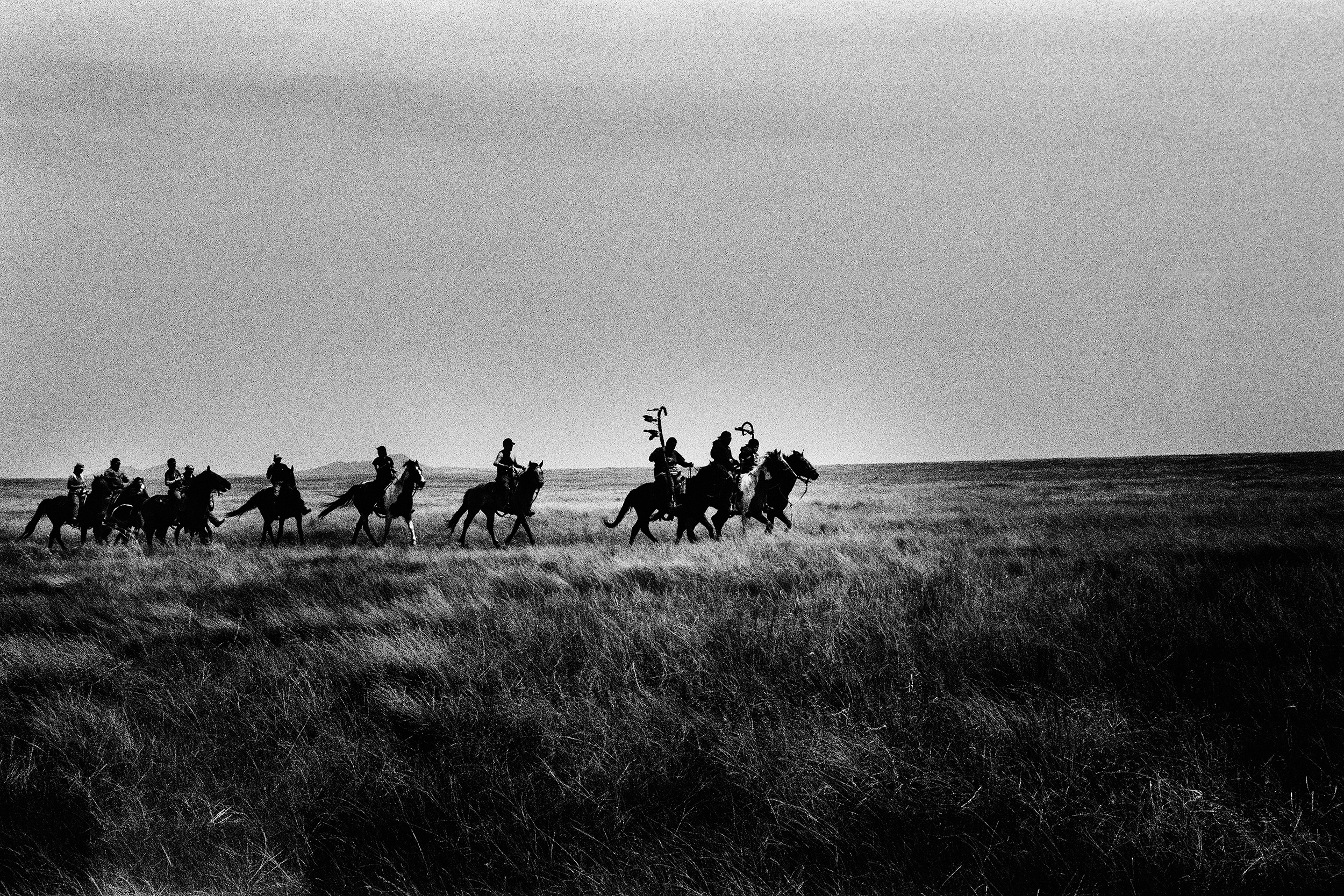
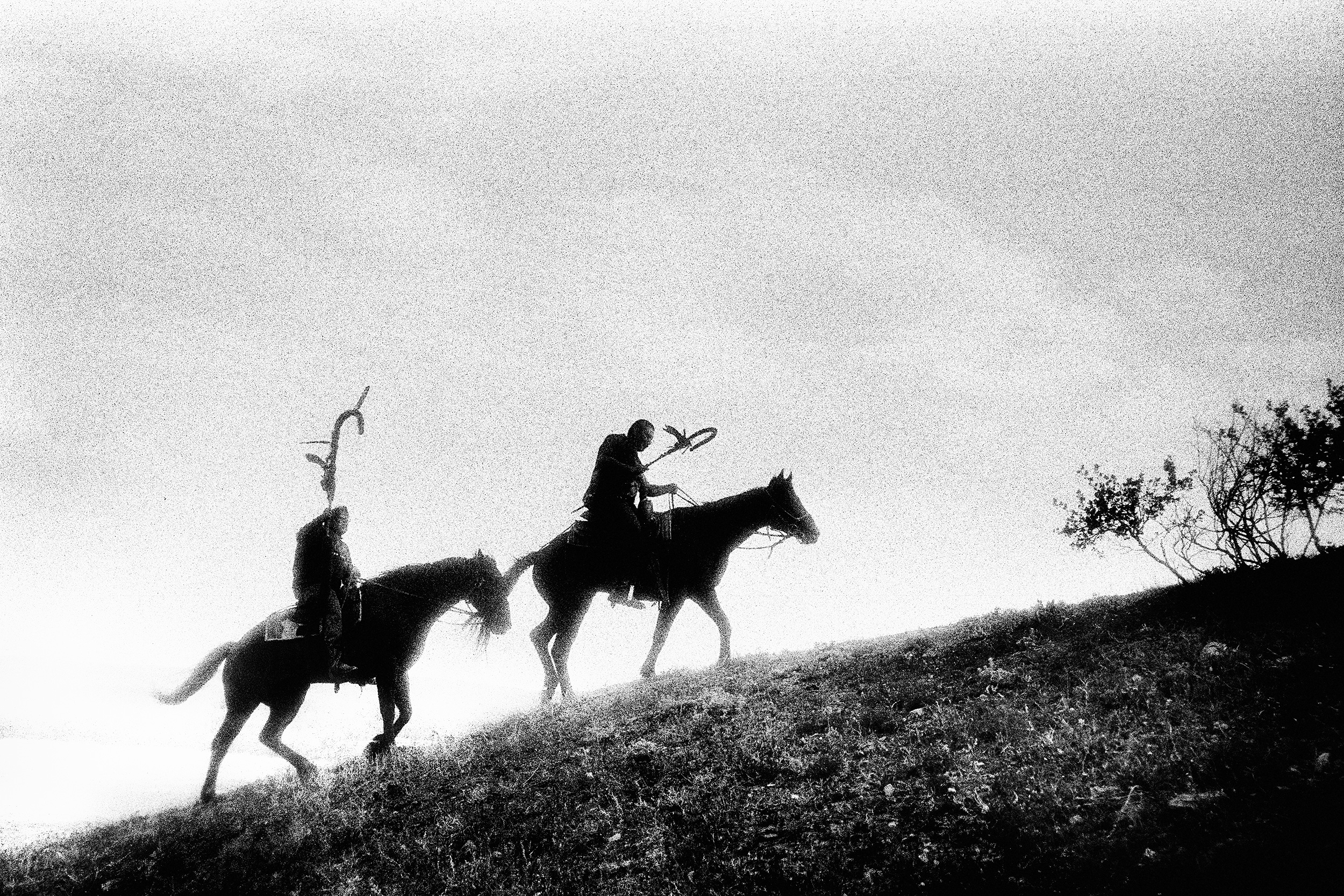
Silhouettes of riders emerge from the blizzard, backlit, horses’ manes lashing the weather-beaten skin of their faces in twenty-below temperatures. The grainy black and white of Simon Vansteenwinckel’s images, with their silver contrasts, transfigures these men into demigods amid the boundless plains of the Dakotas.
Devoted to the great commemorative rides of the Lakota — the people of the Sioux nation —, his documentary essay, published by éditions lamaindonne, has been doubly honoured: with the Prix Nadar “Gens d’images” 2025, France’s oldest award dedicated to the photography book, and with the Prix International La Cense de la Photographie de Cheval, bestowed under the presidency of Viggo Mortensen. Previously exhibited at the Polka gallery in Paris, the series is now on view in Brussels.
Dead Man Riding
The title carries the symbolism of a threshold. In Lakota culture, shadows represent spirits; the land of shadows is where the dead go. Vansteenwinckel conceived the title as a tribute to the victims, but also to the entire history of their people. Two epigraphs open the book, one from American novelist Toni Morrison — “You know as well as I do that people who die bad don’t stay in the ground” —, the other from poet James Welch — “Like shadows on the earth.” Two literary beacons that anchor the project in the territory of unquiet memory.
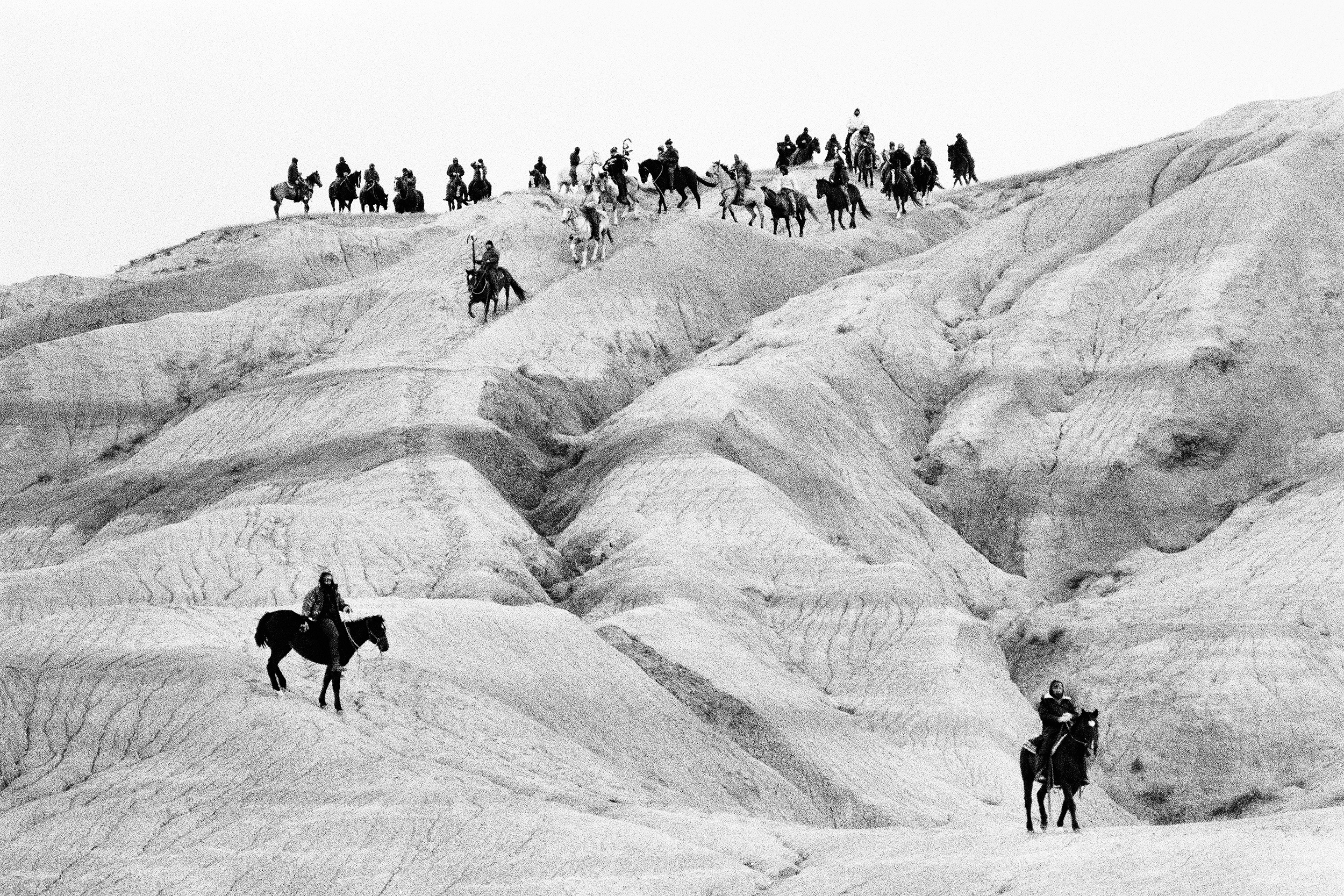
The history is well known, but its brutality does not blunt. On December 29, 1890, at Wounded Knee, the United States Army massacred three hundred members of the Lakota tribe — mostly women and children — along with their chief, Big Foot. Since 1986, every December, riders retrace the path of that original flight: 450 kilometres in fifteen days, through temperatures that can plunge to twenty below zero, across the expanses of North and South Dakota.
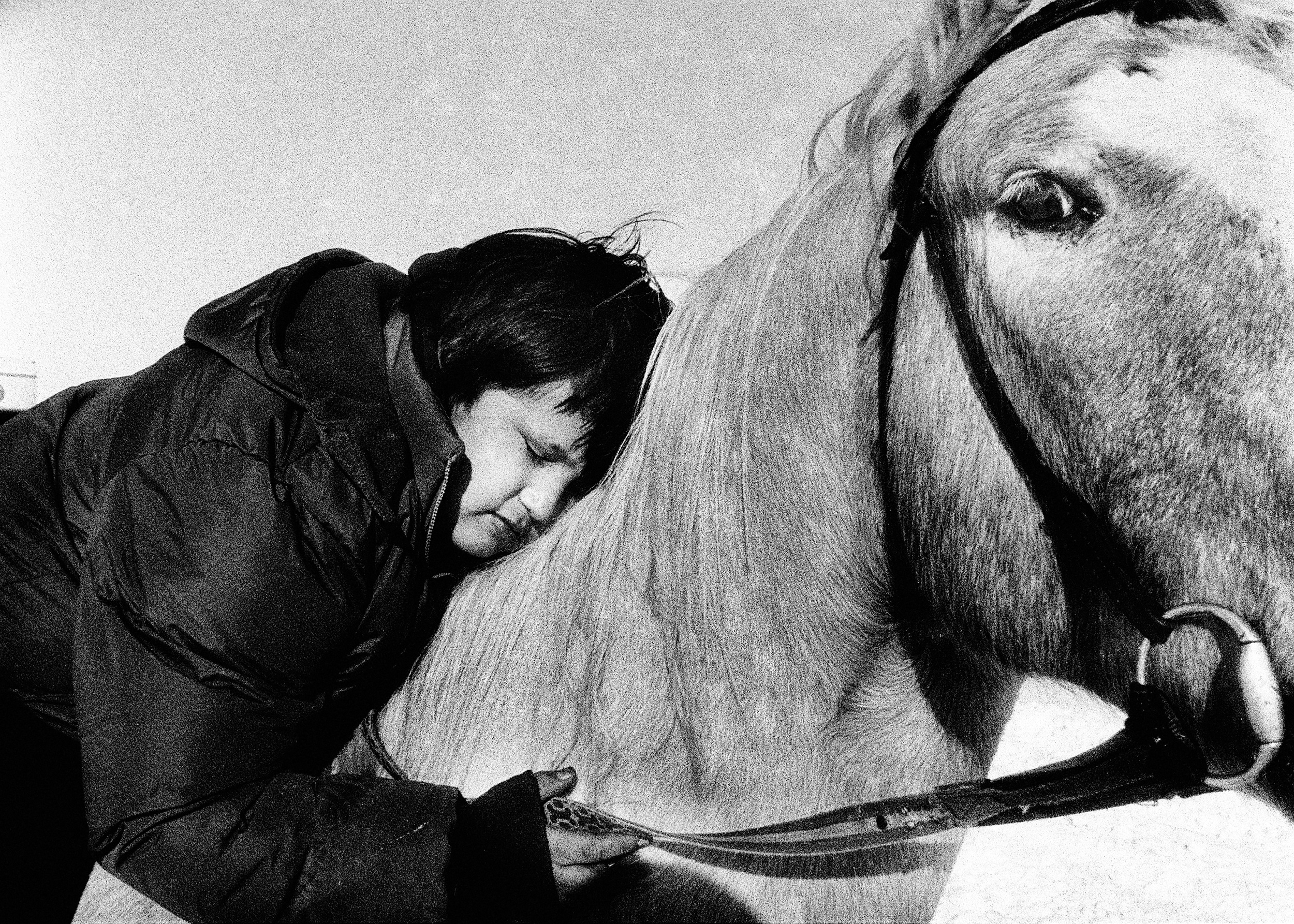
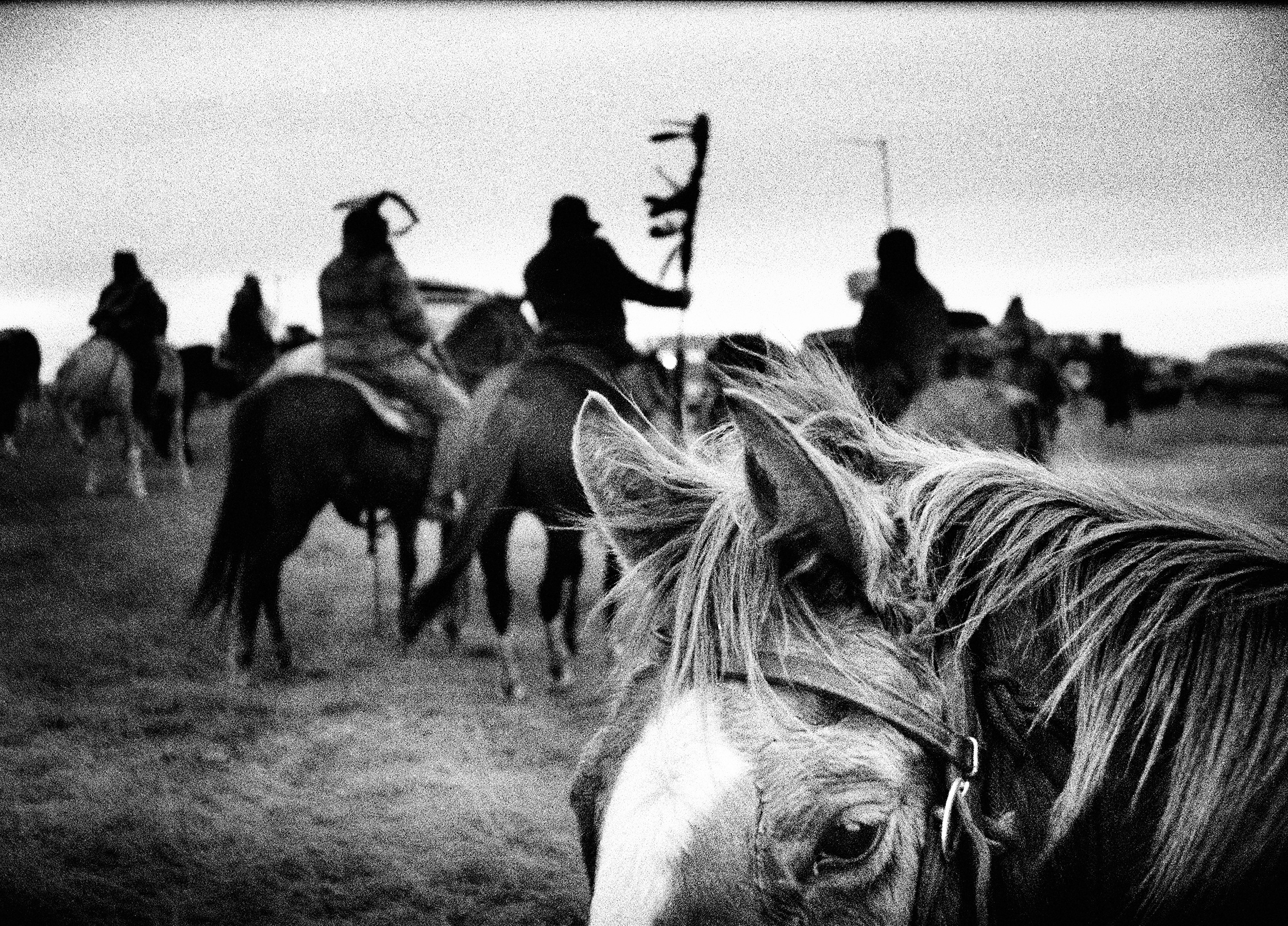
This ride, known as “Omaka Tokatakiya” (“Future Generations Ride”), is no backward-looking pilgrimage. It is a ritual of transmission. “During those two weeks, the elders look after the young, take them out of their daily lives, teach them to ride, to show kindness to the horses, and bring them closer to the soul and history of their nation.” As they say, this is not a stroll but a spiritual ride.
In the Footsteps of Guy Le Querrec
Born in Brussels in 1978, photographer, graphic designer and teacher Simon Vansteenwinckel discovered the Lakota rides through the work of Guy Le Querrec, a member of the Magnum agency and the author, in the early 1990s, of Sur la piste de Big Foot. Before setting foot on the reservations himself, he had to arm himself with patience.
The Lakota are a wary community, burned by decades of reporting that reduced their existence to poverty, destitution and alcoholism. They no longer wish to be seen through that lens. It was ultimately Natosha Luger, from the Standing Rock reservation, who opened the door to him after lengthy exchanges. Without her, he admits, the project would never have come to be.
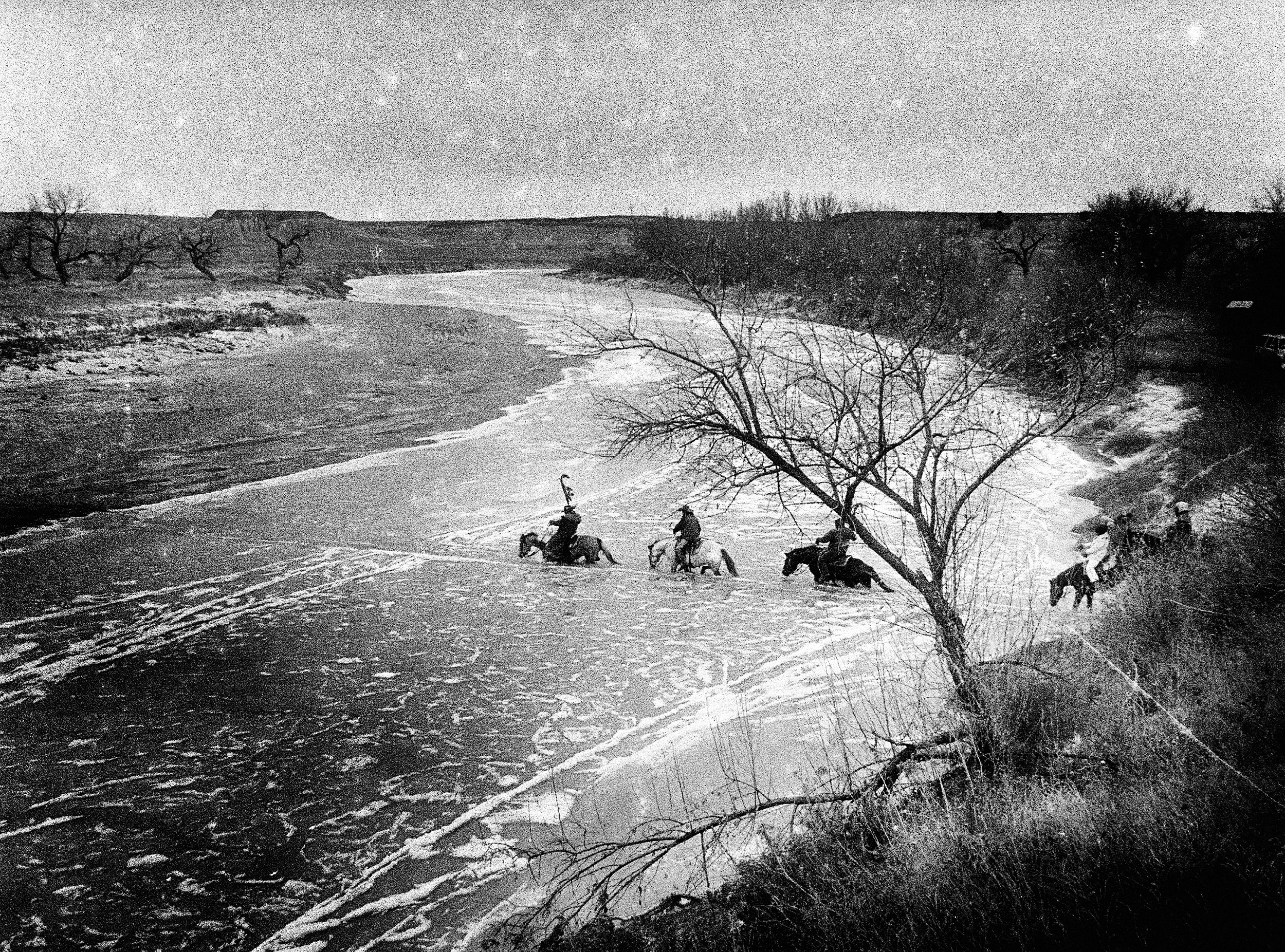
Vansteenwinckel works exclusively with analogue film, using a rudimentary Holga 120 camera that heightens the grain, the pools of shadow and the organic blur. This is no ornamental choice: it interprets reality, shifts it into a register where the intimate and the epic converge. But he knows its limits.
Black and white, applied to such a subject, can tip into romantic imagery, perpetuating the stereotypes that Europe has projected onto Indigenous peoples for centuries. That is why the book is accompanied by texts that recall the political and social reality of the Lakota, anchoring beauty in a truth that aesthetics alone might obscure.
For violence seeps from everywhere. Life expectancy for men on the reservations barely exceeds 45. Half the population suffers from diabetes. Unemployment is endemic. In 2025, some families still had neither sanitation nor running water, at the heart of one of the world’s greatest powers. And that is precisely what the international media usually show of the Indian reservations: a caricature of poverty.
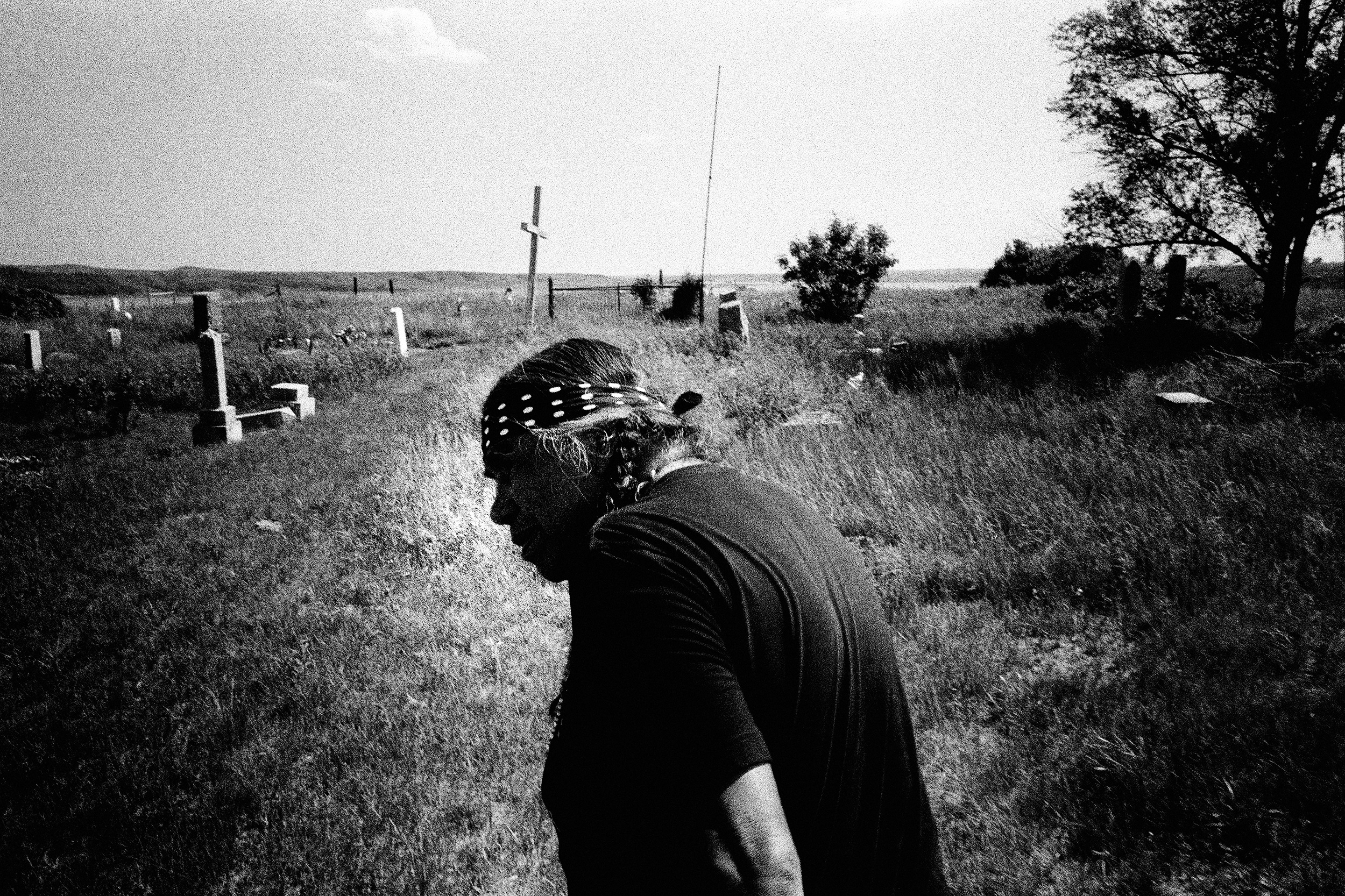
The photographer moves beyond this litany of affliction to capture what no one shows: the uprightness of a people who refuse erasure. For, as he writes, “their power of resilience is immense, the strength of their spirituality intact, and their pride unvanquished; a people who have endured the worst abominations of history yet continue to live and move forward, united and strong.”
In his images, the horse commands a sovereign presence. Introduced to the Lakota in the seventeenth century, it revolutionized the hunt, redefined the art of war, and then became a spiritual being: a bridge between the living and the dead. The images seize that carnal alliance: bodies bent against the storm, the steaming nostrils of horses in the frozen air, equestrian silhouettes rising from the white void of the desert like phantom centaurs summoned from the past.
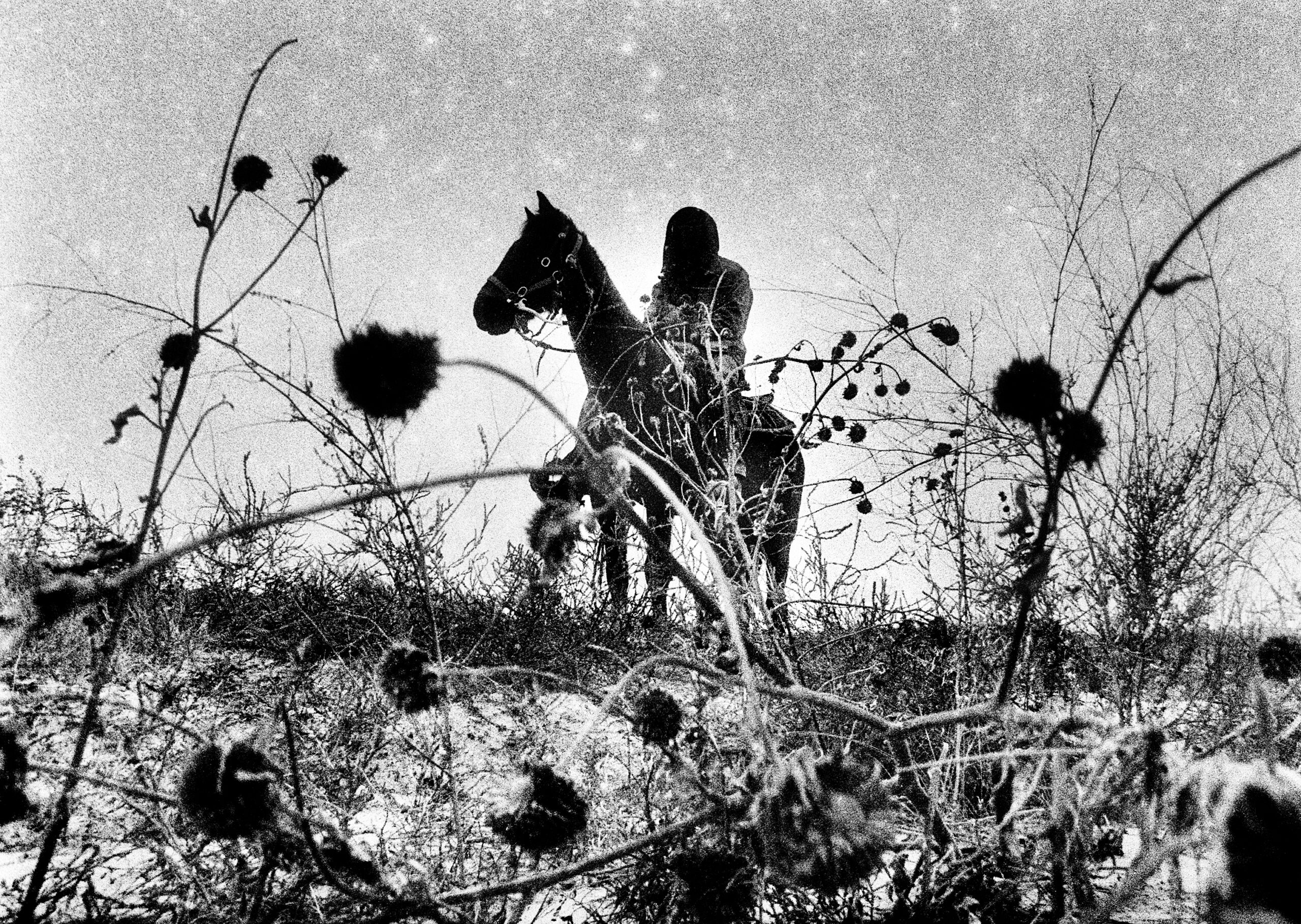
Aux Ombres is not just another handsome book about a distant cause. It is a moral object. A portion of the royalties goes directly to Lakota families to help fund future rides. Next winter, when you dive into these images, remember that somewhere on the plains of the Dakotas, in the heart of the storm, proud and resolute, men keep riding to bring their dead back to life.
The exhibition “Aux Ombres” by Simon Vansteenwinckel runs from March 27 to May 24, 2026 at L’Enfant Sauvage gallery in Brussels. Opening: March 26 at 6pm.
The book Aux Ombres is published by éditions lamaindonne and is available for €46.